
Projects rarely fail because teams lack information. More often, they fail because the right information is in the wrong place, arrives too late, or becomes disconnected from the work it should guide.
The plan is in one tool. Tasks are managed in another. Documents are stored elsewhere, while important decisions circulate through meetings, emails, and messaging apps.
Before long, each team member is working with a different version of the project.
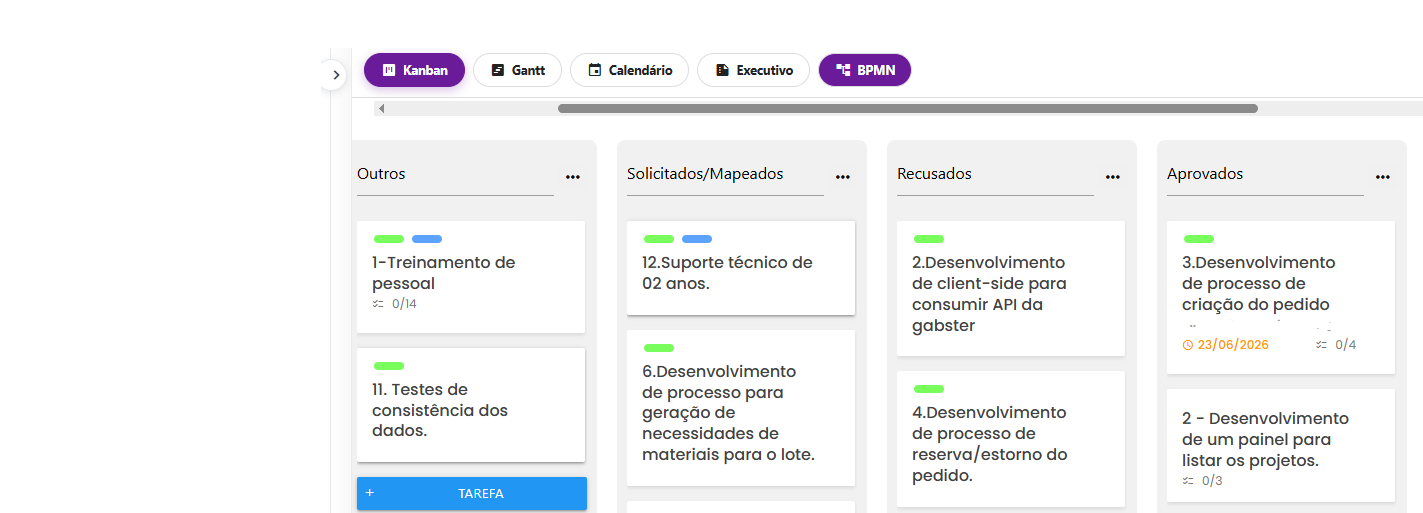
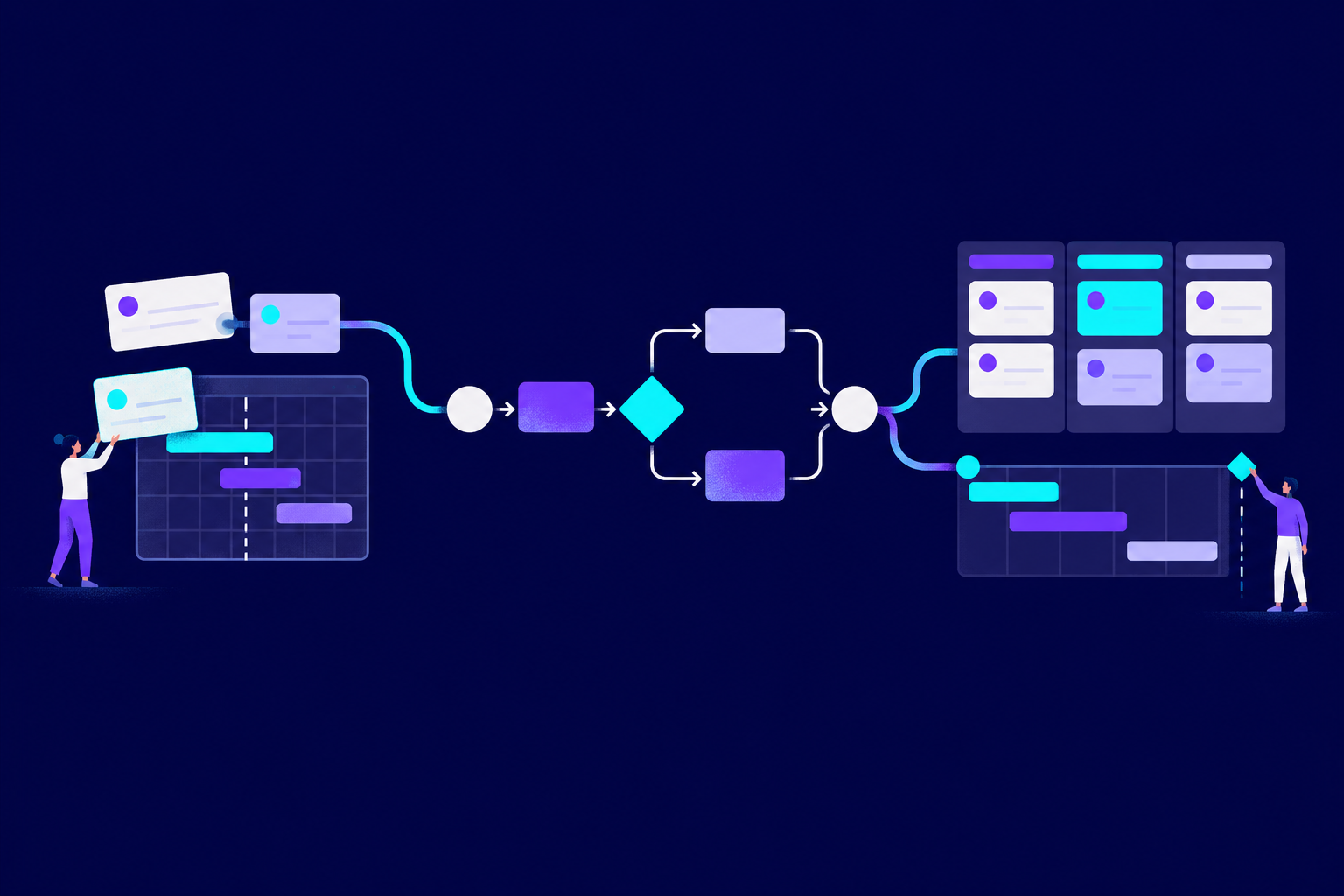
This is precisely the fragmentation that Kanbada addresses by integrating planning, processes, and execution in one environment through Kanban, Gantt, and BPMN.
When planning no longer reflects reality
Planning defines objectives, responsibilities, dependencies, deadlines, and expected results. Execution, however, is constantly changing.
Priorities are revised. Deadlines shift. New constraints emerge. Tasks become blocked, and decisions change the original path.
When those changes are not incorporated into the project environment, misalignment appears: the schedule shows one deadline, the task board presents another priority, and the latest decision exists only in a conversation.
The problem is not merely communication. It is the lack of connection between information.
In Kanbada, Gantt charts help organize deadlines and dependencies, while Kanban boards support daily task execution. Planning and work therefore remain connected, making delays, bottlenecks, and priority changes easier to identify.
Too many tools, multiple versions of the same project
Spreadsheets, messaging apps, calendars, documents, and productivity platforms can solve specific needs. When these tools are disconnected, however, teams must manually transfer information between them.
A deadline changes in the schedule but not in the documentation. A process is updated while tasks continue to follow the previous flow. A new priority is announced through WhatsApp or Slack, but the project board remains unchanged.
The result is a frequent and dangerous question: Which information is correct?
By combining Kanban, Gantt, and BPMN, Kanbada reduces the distance between the different dimensions of a project. Teams can monitor activities, review deadlines, and consult the process that guides the work without depending on information scattered across several systems.
Context disappears during handoffs
Information is also lost when work moves between people or departments.
Strategy defines an objective. A manager turns it into a project. A coordinator creates tasks. Finally, a specialist receives an instruction such as: “Create the landing page.”
But the original context may include essential details: the campaign targets a specific audience, its objective is lead generation, the page will support an advertising campaign, and delivery depends on assets from another team.
If the specialist receives only the task, the execution may be technically correct while still failing to achieve the project objective.
A good platform must therefore communicate not only what needs to be done, but also why, when, how, and where in the process the activity belongs.
In Kanbada, tasks can be connected to processes modeled in BPMN, bringing execution closer to its original context. The planned workflow stops being a static diagram and becomes part of the team's daily work.
Documented processes should guide execution
Many organizations document processes that are rarely used in practice. Diagrams are created, archived, and consulted only when a problem or audit occurs.
Kanbada's BPMN modeling allows organizations to represent activities, decisions, responsibilities, and workflows. It also supports the documentation of business rules, requirements, restrictions, objectives, inputs, and outputs related to modeled processes.
These elements help preserve organizational knowledge and clarify the relationship between the defined process and the tasks being performed.
From task management to context management
Managing projects involves more than creating tasks and moving them between columns. Organizations need continuity between strategy, processes, execution, and monitoring.
Without that continuity, familiar problems emerge: duplicated work, delayed decisions, conflicting priorities, unnecessary meetings, loss of knowledge, and difficulty understanding the true status of a project.
Kanbada was designed to reduce this fragmentation. In a single platform, your organization can model processes with BPMN, manage tasks using Kanban boards, and plan deadlines and dependencies with Gantt charts.
More than organizing activities, Kanbada helps keep context connected to the work throughout the project lifecycle.
Discover Kanbada and learn how to connect processes, planning, and execution in one platform.